In partnership with

We're proud to have Mindstream as today's lead sponsor of Token Metrics, supporting our mission to deliver cutting edge insights and connect the investment community.
Turn AI Into Your Income Stream

The AI economy is booming, and smart entrepreneurs are already profiting. Subscribe to Mindstream and get instant access to 200+ proven strategies to monetize AI tools like ChatGPT, Midjourney, and more. From content creation to automation services, discover actionable ways to build your AI-powered income. No coding required, just practical strategies that work.
Market Overview
Welcome back to Token Metrics. TradFi is marching onchain, derivatives are going onshore, and staking infrastructure is quietly getting an upgrade.
As of Dec 15, 2025, total crypto market capitalization is hovering just above $3.0T, with Bitcoin trading around the high-$80Ks to low-$90Ks and holding roughly 58–59% dominance. Ethereum is consolidating in the low-$3,000s.
Flows into niche products are building under the surface. XRP spot ETFs have logged nearly $1B in net inflows across 30 straight trading days, while tokenized funds and money market products are scaling on public chains. At the same time, derivatives innovation (Cboe’s new Continuous Futures) and staking/liquidity upgrades (mETH’s buffer pool) point to a maturing market structure that increasingly bridges TradFi rails with DeFi infrastructure.
1. JPMorgan Puts $100M Tokenized Money Market Fund on Ethereum

JPMorgan just took a big step out of the permissioned sandbox and onto public Ethereum. The bank launched the My Onchain Net Yield (MONY) fund, a tokenized money market product issued directly on Ethereum mainnet and seeded with $100M from its own balance sheet.
MONY represents shares in a portfolio of short duration U.S. Treasuries and repo. Under the hood, it’s a traditional money market fund. On the surface, investor positions are recorded as onchain tokens that can transfer across Ethereum based rails. The product is built on JPMorgan’s Kinexys tokenization stack and is initially restricted to qualified, KYC’d counterparties.
This is a key shift from earlier efforts like JPM Coin and Onyx, which largely lived on private or consortium chains. By going live on a public L1, JPMorgan is effectively signaling that Ethereum is now acceptable as neutral settlement infrastructure for high grade collateral so long as access is controlled at the edge.

For institutions, MONY offers blockchain based access to a familiar product: a tokenized claim on short term U.S. government exposure that can, in principle, plug into custodians, OTC desks, and compliant DeFi venues that speak ERC 20. Over time, that means:
- Faster collateral mobility: Treasuries can move at block speed between lenders, borrowers, and derivatives counterparties.
- Interoperability with DeFi: Compliant protocols can integrate MONY as a yield bearing, low risk asset for lending, repo, or structured products.
- More onchain RWA standards: Large banks converging on Ethereum increases network effects around tooling, custody, and risk frameworks for tokenized RWAs.
For Ethereum itself, this is structurally bullish. If capital markets participants treat mainnet as settlement for tokenized cash equivalents, it can support higher fee revenue, deeper onchain liquidity, and more sophisticated institutional grade DeFi products. Investors should watch how quickly external institutions onboard, and whether MONY or similar funds begin showing up as collateral on permissioned DeFi platforms.
Further reading: JPMorgan’s tokenized MONY fund on Ethereum.
2. Cboe Launches First U.S.-Regulated ‘Continuous Futures’ for BTC & ETH

Cboe Futures Exchange is going live today with its Bitcoin Continuous Futures (PBT) and Ether Continuous Futures (PET), bringing a perpetual style product into a fully U.S.-regulated wrapper.
These contracts have 10 year terms and use a daily cash adjustment (a funding like mechanism) to keep prices anchored to spot. That design lets traders hold long term exposure without constantly rolling expiring futures, while still approximating the payoff profile of offshore perps.
The contracts are cash settled, centrally cleared via Cboe Clear U.S., and trade 23 hours a day, five days a week. They sit alongside Cboe’s other crypto derivatives, making cross margining and risk management more straightforward for institutions that already use Cboe infrastructure.
Today's Token Metrics insights are brought to you in partnership with Fisher Investments.
Retirement Planning Made Easy

Building a retirement plan can be tricky— with so many considerations it’s hard to know where to start. That’s why we’ve put together The 15-Minute Retirement Plan to help investors with $1 million+ create a path forward and navigate important financial decisions in retirement.
3. mETH Protocol Targets ~24 Hour Redemptions for $2.19B Restaking Pool
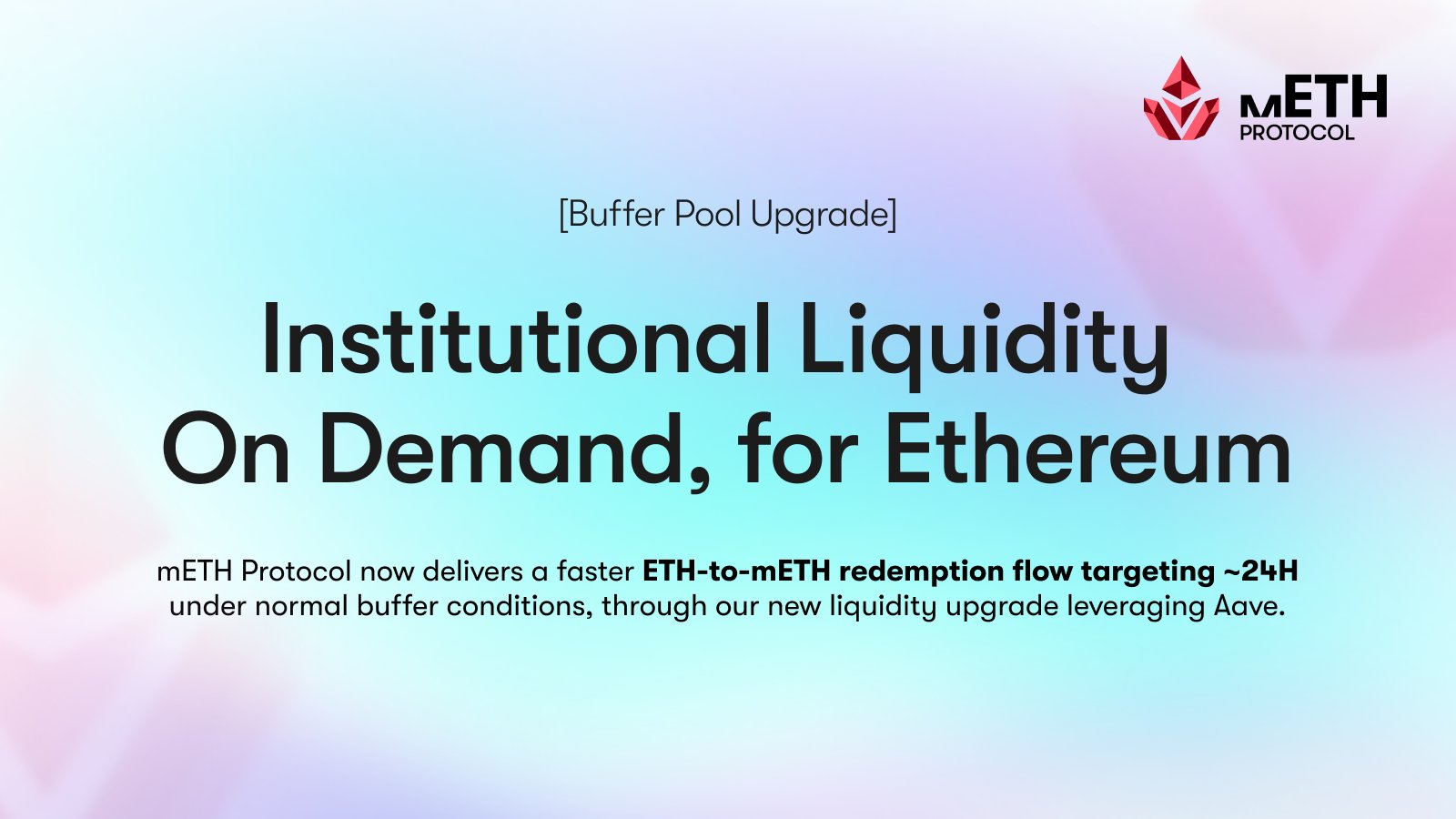
Liquid restaking is booming, but exit friction has been a major pain point. mETH Protocol, a top 10 ETH liquid restaking provider with peak TVL of $2.19B, rolled out a major Buffer Pool upgrade designed to bring redemption times down to roughly 24 hours under normal conditions.
The new architecture pipes ETH liquidity through Aave’s ETH market. mETH continuously supplies ETH into Aave; when users redeem mETH, the protocol taps that liquidity first, then gradually replenishes the buffer via standard beacon chain withdrawals and reserves. Users can still choose the traditional withdrawal route, but the buffer offers a fast lane at par, with no extra fees beyond usual staking economics.
This matters because Ethereum’s exit queues have occasionally stretched beyond 40 days this year, especially during staking demand spikes and restaking driven congestion. For institutions considering large allocations to EigenLayer based strategies, the ability to redeem near T+1, backed by blue chip DeFi money markets, is a key risk management upgrade.
Further reading: mETH’s buffer pool enhancement for ETH redemptions.
4. Token Unlock Wave: ASTER, WCT, STRK Add >$200M in Supply

Today is a heavy unlock day for several mid to large cap tokens. Data from tokenomics trackers highlights a dense cluster of vesting releases on Dec 15, 2025, with more than $200M in supply hitting the market across multiple names.
The largest single event is Aster (ASTER), with an estimated $188.4M unlock around 09:00, equal to roughly 8.27% of its market value. WalletConnect Token (WCT) follows with about $1.41M unlocking versus a ~$14.36M market cap (~9.82%), while StarkNet (STRK) sees roughly $13.2M in new supply released at 15:00 (~2.67% of its market cap).
Most of these tokens are team, investor, or ecosystem allocations coming off vesting schedules not new fundraising rounds. For ASTER, the unlock lines up with the project’s fourth “Aster Harvest” phase, which distributes 1.5% of total supply over six epochs and opens the third airdrop tracking window, with claims live today.
Historically, unlocks of this size relative to circulating supply tend to pressure price in the short term, especially when they coincide with weak order books or risk off sentiment. But the impact is not uniform:
- Projects with deep liquidity and strong staking/locking programs can absorb supply via yield incentives and long term holders.
- Tokens with concentrated investor cliffs and thin CEX/DEX liquidity are more vulnerable to sharp drawdowns.
- Community airdrops can add extra sell pressure if recipients are short term oriented.
Further reading: Detailed breakdown of today’s token unlocks.
Token Metrics is sponsored by Superhuman AI.
Go from AI overwhelmed to AI savvy professional

AI will eliminate 300 million jobs in the next 5 years.
Yours doesn't have to be one of them.
Here's how to future-proof your career:
Join the Superhuman AI newsletter - read by 1M+ professionals
Learn AI skills in 3 mins a day
Become the AI expert on your team